
Every city has its own relationship with food. In Paris, dining is an act of cultural reverence — slow, precise, and bound by centuries of tradition. In Tokyo, it is a discipline, a pursuit of perfection in every detail of preparation and presentation. In New York, it reflects the city’s relentless energy: fast, diverse, and always in motion. Each of these food cultures tells you something real about the society that produced it.
Dubai’s relationship with dining is different from all of them. It is younger, more open, and far more deliberately constructed — but that does not make it any less genuine. Over the past two decades, this city has built a dining culture that is unlike anything else in the world: a place where global influences arrive, collide, and coexist with a hospitality tradition rooted in generosity, community, and the long, unhurried evening.
Understanding that culture — what drives it, what defines it, and what makes it so compelling to the millions of people who experience it every year — is the key to understanding why places like Mehzcla, the best shisha lounge in JBR, have become such a natural and important part of how Dubai eats, gathers, and unwinds.
This piece explores what makes Dubai’s dining culture genuinely distinctive — not just by regional standards, but on a global scale.
A City Built for the World’s Table
Dubai is home to more than 200 nationalities. At any given dinner service, a restaurant in the city might be welcoming guests from India, Lebanon, the United Kingdom, Nigeria, Brazil, South Korea, and Australia — all at once, all expecting something different, and all being served. Nowhere else on earth does the hospitality industry operate at this scale of cultural complexity on a daily basis.
What this has produced is a dining scene of extraordinary breadth. Virtually every cuisine on earth is represented in Dubai — often at a level of quality that matches or exceeds what you would find in its country of origin. Lebanese restaurants here are staffed by Lebanese chefs cooking for a Lebanese diaspora that will not accept any compromise on authenticity. Japanese omakase counters operate to the same standard as Tokyo. Indian restaurants serve regional dishes from states that most visitors to India never even reach.
But Dubai’s dining culture is not simply an accumulation of other people’s food traditions. It has developed a character of its own — shaped by the climate, the calendar, the social habits of its residents, and the particular way that hospitality is understood in this part of the world.
The Evening as the Main Event
In most of the world, dining is organised around the middle of the day. Lunch is the anchor, dinner is the supplement, and breakfast is functional. In Dubai, the rhythm is almost entirely reversed. The heat of the day — particularly between May and September — makes outdoor activity uncomfortable for much of the afternoon. Life moves indoors, life slows down, and then, as the evening arrives and the temperature drops to something bearable, the city wakes up.
This produces a dining culture where the evening meal is not the end of the day but its central event. Restaurants fill between 8pm and midnight. Tables turn late. A dinner reservation for 9:30pm is entirely normal. The evening is where Dubai does its social living — and this shapes everything about how its restaurants are designed, staffed, and experienced.
It also shapes what kind of food travels well in this context. Cuisines built for sharing, for long tables, for dishes that arrive gradually rather than all at once — these are the ones that thrive in Dubai’s evening dining culture. It is a significant part of the reason Mediterranean food has become a favourite for long, social dining in Dubai: the rhythm of mezze, grills, and shared plates is a natural match for the pace and spirit of a Dubai evening.
Hospitality as a Cultural Value, Not a Service Standard
In many parts of the world, hospitality is a professional standard — something that is trained into staff and measured against a benchmark. In Dubai, and particularly within the Arab and South Asian communities that make up a large part of the city’s population, hospitality is a cultural value that exists before any training takes place. The instinct to welcome a guest, to ensure they feel looked after, to make them stay rather than hurry them out — this comes from somewhere deeper than a service manual.
Guests who dine in Dubai frequently comment on a quality that is difficult to name but easy to feel: a genuine warmth in the service that goes beyond professionalism. It is not performative. It does not disappear when the restaurant is busy or when the guest is awkward or when the order is complicated. It is simply the way the culture understands what it means to have someone at your table.
This matters enormously for the quality of the dining experience. A meal in which you feel genuinely welcomed — where the staff remember your name, where your preferences are anticipated rather than asked for each time, where nothing about the interaction feels transactional — is a categorically different experience from one that is merely competent. Dubai’s best restaurants understand this. It is one of the reasons that visitors from cities with technically superior food scenes often report that they ate better, in the broadest sense of the word, in Dubai.
The Social Ritual of Shisha
No element of Dubai’s dining culture is more distinctively its own than shisha. In other cities, shisha is a niche habit or a novelty. In Dubai, it is woven into the fabric of how people socialise — a ritual that sits at the intersection of the city’s Arab heritage and its cosmopolitan present.
The function of shisha in a Dubai evening goes well beyond the product itself. It is a reason to stay. A long, slow draw on a well-prepared pipe creates a natural pause in the conversation — and then a return to it, and another pause, and another return. The evening extends. Topics deepen. People who arrived as acquaintances leave as friends. Shisha, done properly and in the right environment, is one of the most effective social technologies that dining culture has ever produced.
There is genuine data behind this observation. Guests stay longer at restaurants that offer shisha and views — not because they have nowhere else to be, but because the combination of sensory comfort, social warmth, and a setting worth lingering in makes leaving feel like the wrong choice. In a dining culture built around the long evening, this is exactly the outcome that the best venues are designed to produce.
Mehzcla has built its entire experience around this understanding. The shisha offering at JBR is not an add-on to the menu — it is central to the rhythm of the evening, as integral to the experience as the food and the view.
Global Ambition, Local Soul
What makes Dubai’s dining culture genuinely interesting — rather than simply impressive — is the tension it navigates between global ambition and local identity. The city wants to be, and largely is, a destination that competes with London, New York, and Singapore for culinary prestige. It has the restaurants, the chefs, the investment, and the clientele to make that comparison credible.
And yet the soul of the dining culture is not global. It is rooted in the traditions of the Gulf, in the Arab understanding of what it means to be a host, in the South Asian diaspora that has brought the richness of Indian, Pakistani, and Sri Lankan cooking into the city’s daily life, and in the Lebanese and Levantine influence that runs through so much of the city’s social fabric. These are not influences that Dubai has imported and then discarded. They are the foundation on which everything else has been built.
For visitors trying to navigate the city’s extraordinary variety, finding the best restaurant in Dubai is less about identifying a single winner and more about understanding which kind of experience you are looking for. The city can give you almost any answer — but the most satisfying ones tend to be those that combine global quality with something that could only have happened here.
JBR and the Outdoor Dining Tradition
One of the most visible expressions of Dubai’s dining culture is the outdoor terrace. In cities with less forgiving climates, outdoor dining is a seasonal bonus — something to be enjoyed briefly before retreating inside. In Dubai, the outdoor terrace is a year-round institution for much of the calendar, and even in the summer months, the evening breeze and the proximity to the sea makes certain locations genuinely comfortable long after the sun has gone down.
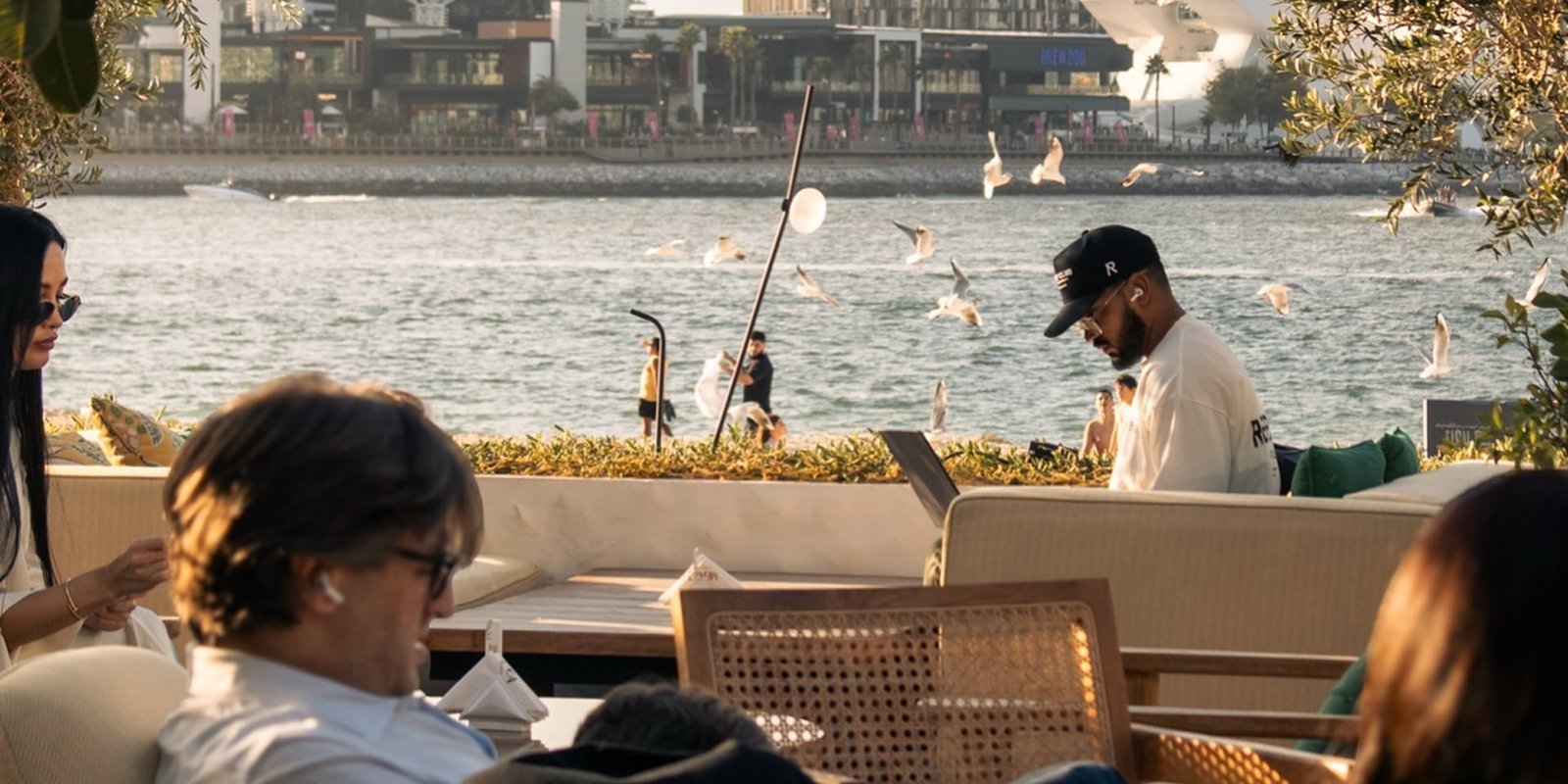
JBR is the heartland of this tradition. The promenade along The Beach is lined with dining terraces that face the water, and the community that gathers there on any given evening reflects the full diversity of the city — residents and tourists, families and couples, solo diners and large groups, all coexisting in the particular easy-going energy that a beachfront location produces.
For those experiencing this part of the city for the first time, our first-time visitor’s guide to dining in JBR covers everything you need to know about how to approach the area, what to expect, and how to make the most of an evening on the waterfront.
Mehzcla’s position at The Beach puts it at the centre of this tradition. The four themed spaces — Ibiza, Mykonos, Capri, and Marrakech — each reflect a different corner of the Mediterranean world, but they share the same fundamental understanding of what a great outdoor dining experience should feel like: generous, unhurried, sensory, and alive to the particular quality of the evening around them.
What Dubai’s Dining Culture Offers That Others Cannot
Every great dining city has something that is difficult to replicate elsewhere. Paris has its terroir and its centuries of culinary institution. Tokyo has its precision and its particular form of craft dedication. New York has its relentless energy and its democratic diversity.
Dubai’s unreplicable quality is its simultaneity. This is a city where you can eat superbly in twenty languages in a single evening, where the service culture carries genuine warmth rather than professional distance, where the evening begins late and earns its length, and where the outdoor setting — the sea, the sky, the warmth of the air — adds a dimension to the meal that cannot be designed or manufactured. It simply has to be there.
For a restaurant like Mehzcla, this is the context in which everything makes sense. A Mediterranean shisha lounge on a JBR beachfront terrace, serving food and drinks that reflect the coastal cultures of four different Mediterranean cities, to a clientele that might have come from anywhere in the world and chosen to spend their evening here — this is Dubai’s dining culture expressed in a single address. Global in its ambitions, local in its warmth, and entirely its own.
Experience Dubai’s Dining Culture at Mehzcla
Dubai’s dining culture is best understood not through description but through participation. It is something you feel when you sit down at the right table, in the right setting, with the right people, and realise that the evening has taken on a quality that you weren’t entirely expecting.
That is what Mehzcla is here to give you. As the best shisha lounge in JBR, we sit at the centre of one of the city’s most vibrant dining neighbourhoods — and every evening, we bring together the warmth, the variety, the views, and the unhurried spirit that makes Dubai’s dining culture something genuinely worth experiencing.
We are open daily from 10:00 AM to 4:00 AM at The Beach, JBR, Dubai. Reserve your table via WhatsApp and come and see what Dubai dining really looks like.
Frequently Asked Questions
Dubai's dining culture is defined by several things that are difficult to find elsewhere in combination: an extraordinary diversity of authentic cuisines from around the world, a hospitality tradition rooted in genuine Arab and South Asian cultural warmth, a social calendar built around the evening rather than the midday meal, and a year-round outdoor dining culture shaped by the city's climate and its position on the coast. The result is a dining experience that is simultaneously global in its range and genuinely local in its character.
Shisha is deeply embedded in the social fabric of Dubai's Arab heritage and has become one of the defining rituals of an evening out in the city. Unlike many aspects of the dining experience, shisha is not about efficiency — it is about slowing down, extending the evening, and deepening the social experience around the table. For a city whose dining culture is built around the long, unhurried evening, shisha is a natural and central part of how people gather and connect.
JBR is one of Dubai's most consistently enjoyable dining destinations. The combination of direct beachfront access, open-air terraces, a varied range of restaurant experiences, and the community energy of The Beach promenade makes it a location that works for virtually any occasion. Whether you are visiting for the first time or looking for a reliable evening out as a resident, JBR offers a quality and variety of dining that is difficult to match elsewhere in the city.
Mehzcla offers a Mediterranean restaurant and shisha lounge experience at The Beach, JBR — with four distinctly themed spaces inspired by Ibiza, Mykonos, Capri, and Marrakech. Guests can enjoy a full food menu spanning all-day breakfast, lunch, dinner and everything in between, alongside an extensive beverages offering and premium shisha service. The location on the waterfront, with views of the Dubai Eye and the Arabian Gulf, makes Mehzcla one of the most complete dining and shisha experiences that JBR has to offer.